The Business Class
Women’s Fashion Accessories Store Business Plan | Detailed Project Report – DPR
Women’s Fashion Accessories Store Business Plan | Detailed Project Report – DPR
Couldn't load pickup availability
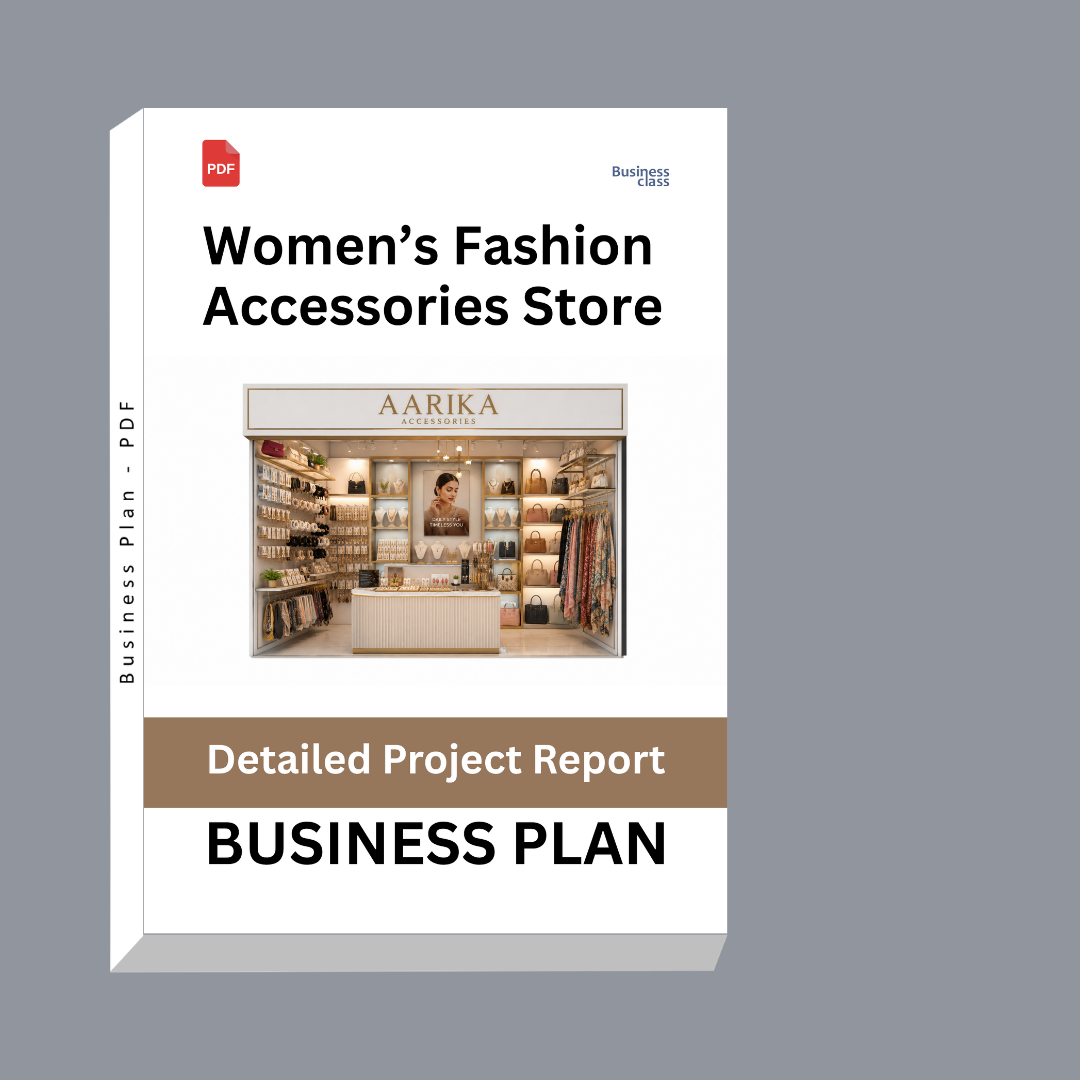
The Women’s Fashion Accessories Store Business Plan is a 54-page PDF eBook designed to support structured planning for a specialist accessories retail business. It combines a Detailed Project Report – DPR and Business Plan approach to help aspiring entrepreneurs, retail founders, students, and business-planning readers examine the model before committing resources. Coverage includes the business concept, market research, product and pricing strategy, store format, promotion, staffing, operating processes, infrastructure and equipment, costing, sales planning, profit and cash-flow planning, start-up capital, financing assumptions, break-even analysis, scenario analysis, working capital, KPIs, risks, launch actions, and a final viability review. Financial, regulatory, and operating assumptions should be independently validated for the reader’s own circumstances.
Overview of the Business and PDF eBook
The Women’s Fashion Accessories Store Business Plan is a 54-page PDF eBook focused on planning a compact specialist retail store for women’s accessories. It combines the structure of a Detailed Project Report – DPR with a practical Business Plan, covering the business idea from market positioning and assortment planning through operations, financial projections, launch preparation, risk control, and viability review.
The retail model centers on fashion jewellery, hair accessories, handbags and slings, scarves, belts, and gift-ready accessory sets. The plan studies a small-format, visually merchandised store supported by repeat-customer communication and social-media-assisted selling. It is designed as a cautious first-year planning model rather than a high-growth promise.
Why Consider or Study This Business
A women’s fashion accessories store can be useful to study because the category combines frequent style refreshes, gifting occasions, impulse purchases, and products across different ticket sizes. The eBook explains how lower-ticket jewellery and hair accessories can support purchase frequency, while handbags and gift sets can contribute higher basket values.
The model also shows why assortment freshness, visible presentation, price discipline, store frontage, stock rotation, and customer service matter in accessories retail. Unlike full apparel retail, the proposed format does not depend on trial rooms or deep size-based inventory. This makes store layout, buying discipline, display quality, and fast replenishment especially important.
How the Detailed Project Report – DPR and Business Plan Support Planning
The Detailed Project Report – DPR and Business Plan organize the idea into connected planning areas so readers can examine whether the concept is workable before making commitments. The eBook starts with the business idea and market research, then develops product, price, place, promotion, people, process, and physical-evidence planning.
It also moves beyond marketing into staffing, operating workflows, infrastructure, equipment, packaging, utilities, costing, sales forecasts, fixed and variable costs, profit planning, cash flow, start-up capital, funding structure, loan repayment, break-even analysis, scenario testing, capacity checks, working-capital management, and operating KPIs.
Importantly, the eBook does not present projections as guaranteed outcomes. Its figures and assumptions form a planning model that readers should test against their own market conditions, supplier quotations, premises costs, financing terms, legal requirements, taxes, staffing costs, and expected customer demand.
What the Reader Will Learn
Readers can study how a specialist accessories retailer may be structured around a curated range rather than deep inventory in a small number of styles. The product strategy covers everyday basics, seasonal or festive pieces, office-friendly styles, gifting combinations, quality checks, display methods, packaging, and planned assortment refreshes.
The operations material explains a buy-display-sell-replenish cycle. It covers trend scanning, supplier sourcing, receiving and quality checks, price coding, display allocation, daily selling, customer data capture, cash and stock review, best-seller reordering, and ageing-stock control.
The financial planning sections show how product purchase costs and fixed operating costs connect to pricing, sales, profit, cash flow, start-up funding, debt servicing, break-even, and scenario analysis. Readers also see how capacity, stock holding, cash conversion, and monthly KPIs can be used to monitor the business after launch.
Major Subjects Covered
- Business introduction, executive summary, business idea, and opportunity overview
- Market research covering customer groups, needs, competitors, positioning, and product-category gaps
- Product assortment, pricing approach, store-place considerations, promotion, people, process, and physical evidence
- Sales estimation and monthly product-level sales planning
- Organization structure, staffing responsibilities, skills, and operating support
- Legal responsibilities, insurance considerations, and a compliance-renewal framework requiring local verification
- Store infrastructure, display fixtures, billing technology, utilities, storage, opening inventory, packaging, and quality-control requirements
- Product costing, fixed and variable cost planning, profit planning, and cash-flow planning
- Start-up capital allocation, funding structure, loan repayment assumptions, and break-even analysis
- Downside, base, and upside scenario analysis plus store-capacity and utilization checks
- Founder readiness, launch actions, working-capital cycle, KPI tracking, planning assumptions, risk mitigation, and final viability review
- A plan-defense question-and-answer section for explaining the business logic in structured discussions
Who This eBook Is For
This PDF eBook is suitable for aspiring entrepreneurs considering a women’s fashion accessories store, existing retailers evaluating a specialist accessories format, students studying retail business planning, and readers who want a detailed project-report style reference before preparing their own forecasts and operating plan.
It may also help business partners divide responsibilities across store operations, buying, merchandising, marketing, stock control, customer service, and financial review. Because the eBook includes a launch sequence and ongoing KPI framework, it is most useful for readers who want to think beyond the opening day and plan how the store will be monitored during its first operating year.
Product Specifications
- Product type: Business-planning eBook
- Format: PDF
- Subject: Women’s Fashion Accessories Store
- Purpose: Educational, business-planning, project-evaluation, and start-up preparation
- Language: English
- Page count: 54 pages
- Business model covered: Compact specialist retail store with direct customer sales and repeat-customer support
- Product categories covered: Fashion jewellery, hair accessories, handbags and slings, scarves, belts, and gift-ready accessory sets
- Planning coverage: Market research, marketing, staffing, operations, infrastructure, equipment, costing, sales, profit, cash flow, start-up capital, funding, loan planning, break-even, scenarios, capacity, working capital, KPIs, risks, launch actions, and viability assessment
Frequently Asked Questions
1. Is this a complete Women’s Fashion Accessories Store Business Plan?
It provides a broad first-year planning model covering the business concept, market, marketing, operations, staffing, setup requirements, financial planning, risk control, launch preparation, KPIs, and viability review.
2. Does the eBook include a Detailed Project Report – DPR structure?
Yes. It combines project-report style evaluation with Business Plan sections, including start-up requirements, operating assumptions, financial projections, break-even analysis, scenario analysis, funding, and risk assessment.
3. Which accessory categories are covered?
The plan covers fashion jewellery, hair accessories, handbags and slings, scarves, belts, and gift-ready accessory sets.
4. Does it include store setup and equipment requirements?
Yes. The eBook discusses premises, display fixtures, mirrors, counters, storage, billing technology, security equipment, lighting, utilities, packaging materials, and opening inventory requirements.
5. Are marketing and sales planning included?
Yes. Coverage includes product strategy, pricing, store-place considerations, promotion, customer-facing people and processes, physical presentation, sales estimation, and monthly sales planning.
6. Does it include financial planning?
Yes. The eBook includes costing, fixed and variable costs, profit planning, cash flow, start-up capital, funding assumptions, loan repayment, break-even calculations, scenario testing, and working-capital analysis.
7. Can the plan be used in any market?
It can be used as a planning reference, but the underlying financial, market, legal, tax, licensing, financing, and operating assumptions must be independently checked and adapted to the reader’s own circumstances.
8. Does the eBook guarantee funding or business profitability?
No. The projections are planning estimates, not guarantees. Actual costs, demand, financing terms, compliance requirements, sales, margins, and results can differ.
Disclaimer
This eBook is for educational and business-planning purposes. Financial estimates, market assumptions, operating assumptions, and other projections require independent validation before use. Legal, tax, licensing, regulatory, financing, insurance, employment, and commercial requirements vary, and actual business results depend on many factors outside the scope of a planning document. Readers should obtain appropriate professional advice and verify all assumptions before making investment, financing, legal, tax, regulatory, or operational decisions.
Share