The Business Class
Men’s Fashion Accessories Store Detailed Project Report – DPR & Business Plan
Men’s Fashion Accessories Store Detailed Project Report – DPR & Business Plan
Couldn't load pickup availability
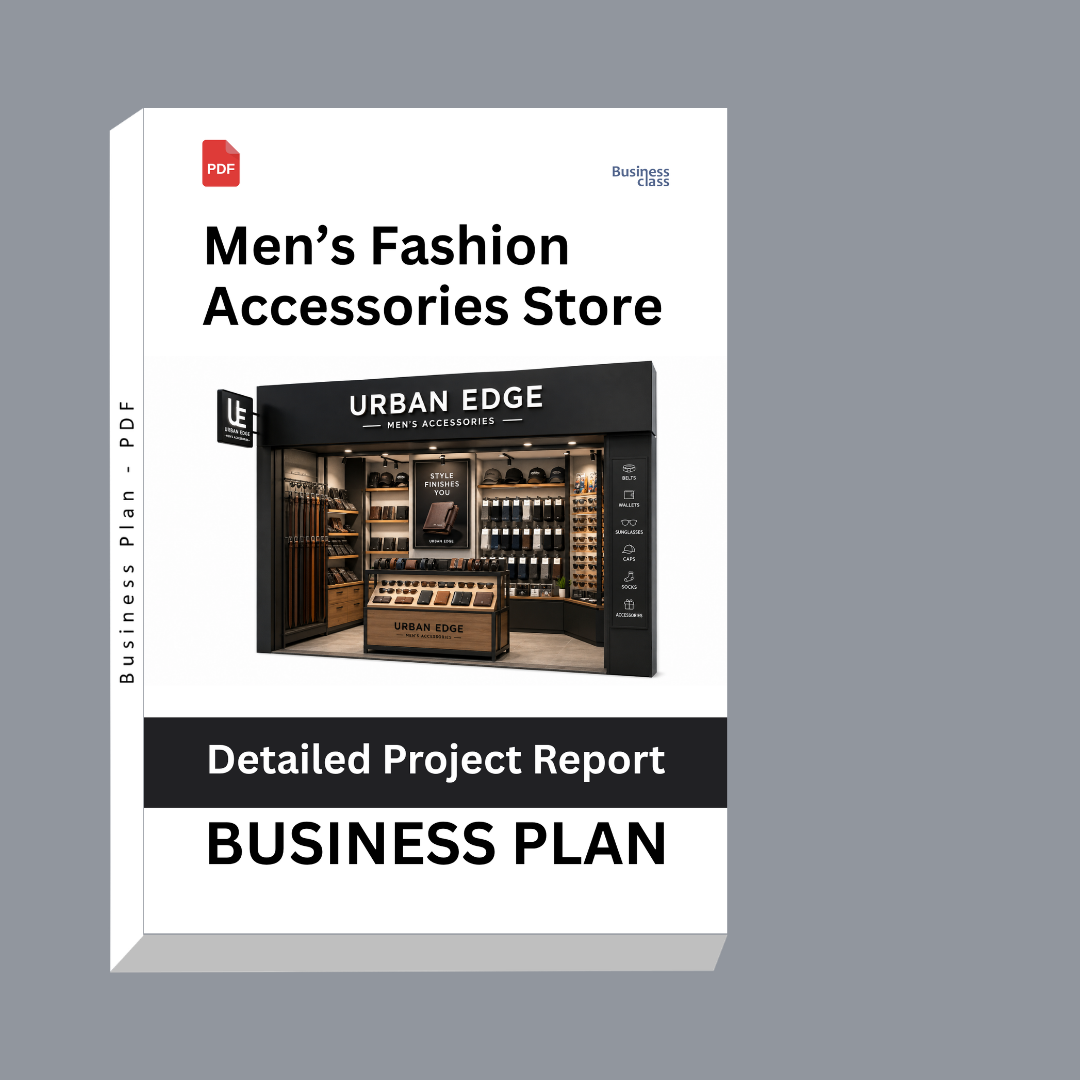
This Men’s Fashion Accessories Store Business Plan PDF eBook is a practical planning resource for studying how to set up and manage a focused men’s accessories retail business. The Detailed Project Report – DPR and Business Plan is designed for aspiring entrepreneurs, first-time store founders, business students, mentors and readers evaluating a compact retail concept. It covers the business idea, customer groups, product mix, market research, marketing, pricing, store operations, staffing, infrastructure, costing, sales planning, cash flow, start-up capital, loan repayment, break-even analysis, scenarios, risks, compliance planning and launch actions. Use it as an educational planning reference for evaluating requirements, operating controls and financial assumptions before making independent business decisions.
Overview of the Business and PDF eBook
The Men’s Fashion Accessories Store Business Plan is a 46-page PDF eBook developed as a structured planning case for a specialist retail store focused on practical, style-led and gift-ready accessories for men. The Detailed Project Report – DPR and Business Plan examines a compact retail format selling products such as belts, wallets, cardholders, ties, cufflinks, pocket squares, sunglasses, caps, socks and small add-on items.
The eBook moves from the basic business concept into market research, product planning, pricing, selling channels, promotion, staffing, daily operating processes and store presentation. It then develops a financial-planning framework covering sales estimation, costs, profit planning, cash flow, start-up capital, loan repayment, break-even analysis, scenario testing and working-capital control. Later sections address founder readiness, launch tasks, compliance planning, key performance indicators, assumptions, risks and the overall viability assessment.
Rather than presenting a general article about fashion retail, the eBook follows a defined first-year store-planning model. Readers can study how individual decisions about assortment, staffing, merchandising, purchasing, customer service, cost control and inventory management connect to the wider business plan.
Why Consider or Study This Business
A men’s fashion accessories store can be studied as a focused retail model because it brings together everyday products, occasion-led purchases and gifting within a relatively compact assortment. The eBook identifies customer use cases including office wear, casual use, weddings, festivals and gifts. It also examines several customer groups, including working professionals, students, wedding shoppers and gift buyers.
The product mix is designed around both core lines and add-on purchases. Belts and wallets support practical buying, while ties, cufflinks and pocket squares address formal and occasion-led needs. Sunglasses and caps add style-led categories, while socks and smaller accessories can support repeat or impulse purchasing.
The planning model also shows why inventory discipline matters. A specialist store can benefit from clear visual merchandising and curated choice, but slow-moving stock can tie up working capital. The eBook therefore repeatedly connects product selection with sell-through, reordering, margin control, customer conversion and cash management.
How the Detailed Project Report – DPR and Business Plan Support Planning
The Detailed Project Report – DPR and Business Plan provide a structured way to evaluate the store before committing to a launch. The report organizes the concept into linked operating and financial sections so readers can see what must be planned, measured and validated.
The business-planning sections cover the proposed product offer, target customers, competitive gaps, pricing logic, distribution approach, promotional methods, people requirements, customer-service process and physical retail environment. Operational sections explain procurement, stock receiving, quality checks, tagging, display, billing, daily reconciliation and reorder reviews.
The financial sections show how a retail project report can connect unit sales, variable costs, fixed costs, start-up requirements, funding, repayment obligations, break-even calculations and cash flow. Scenario analysis and capacity checks are also included so the reader can study how sales performance and operating limits affect the plan.
The eBook does not remove the need for independent market, financial, legal or regulatory verification. Its value is in showing a complete planning structure and the relationships between key retail decisions.
What the Reader Will Learn
Readers can use the eBook to understand:
- How a focused men’s accessories retail concept can be defined around everyday, formal, casual and gifting needs.
- How customer groups and competitor gaps can inform assortment and positioning.
- How product categories can be planned with quality, style, packaging, bundle and standards considerations.
- How pricing, promotions and cross-selling can be connected to margin and basket value.
- How a compact store can organize display, billing, packaging and customer capture.
- How procurement, inward stock checks, tagging, merchandising and reordering fit into daily operations.
- How staffing roles can be divided between owner oversight, selling and stock support.
- How sales estimates, cost plans, profit planning, cash flow, start-up capital and break-even analysis are structured.
- How working capital, inventory movement, key performance indicators and risk controls can be monitored during the first year.
- How a launch action plan, compliance calendar and founder-readiness review can support implementation.
Major Subjects Covered
The eBook begins with an executive summary, business idea and market research. It then presents a multi-part marketing plan covering product, price, place, promotion, people, process and physical evidence. Product planning includes belts, wallets and cardholders, formal accessories, sunglasses, caps, socks and add-ons, with attention to style, packaging and quality-control considerations.
The operations material covers organization structure, staffing, legal-form considerations, responsibilities and insurance, daily operating processes, infrastructure, equipment, inputs, packaging and utilities. The report also considers a point-of-sale setup, barcode and billing tools, security equipment, shelving, displays, lighting, mirrors, cooling, packaging supplies and other practical store requirements.
Financial-planning coverage includes costing, sales estimation, sales planning, cost planning, profit planning, cash flow, required start-up capital, sources of capital, a loan repayment schedule, break-even analysis and scenario analysis. The report further includes a capacity and utilization check, working-capital cycle and a year-one KPI dashboard.
Execution-focused sections cover founder readiness, launch actions, compliance and renewal planning, lender or mentor Q&A, key assumptions, risks and mitigation, and a final viability verdict. The closing material also discusses business-support and credit pathways that require current independent verification before use.
Who This eBook Is For
This PDF eBook is suitable for aspiring entrepreneurs studying a men’s fashion accessories store, first-time retail founders, business-plan learners, students working on retail project-report assignments, mentors reviewing a small-store concept and readers comparing specialist retail opportunities.
It may also be useful for someone preparing questions for suppliers, landlords, lenders or other professional advisers. The eBook can help readers identify the areas that require evidence and validation before committing money, signing agreements or opening a store.
Product Specifications
- Product type: Business-planning eBook
- Format: PDF
- Subject: Men’s fashion accessories store
- Purpose: Educational and business-planning reference for a first-year retail store model
- Language: English
- Page count: 46 pages
- Coverage: Business concept, market research, marketing, product mix, pricing, operations, staffing, infrastructure, equipment, costing, sales, profit, cash flow, start-up capital, funding, loan repayment, break-even, scenarios, capacity, working capital, KPIs, launch planning, compliance, assumptions, risks and viability assessment
Frequently Asked Questions
1. What business does this eBook cover?
It covers a specialist men’s fashion accessories retail store selling categories such as belts, wallets, cardholders, formal accessories, sunglasses, caps, socks and small add-ons.
2. Is this a Business Plan or a Detailed Project Report – DPR?
It is structured to serve both purposes. The eBook combines Business Plan sections covering the concept, customers, marketing and operations with Detailed Project Report – DPR elements such as infrastructure, staffing, costing, start-up capital, loan repayment, break-even, scenarios and implementation planning.
3. Does the eBook include financial planning?
Yes. It includes sales estimation, costing, a sales plan, cost plan, profit plan, cash-flow plan, start-up capital, funding structure, loan repayment, break-even analysis, scenario analysis and working-capital planning. The figures are planning assumptions and require independent validation.
4. Does it cover store operations and equipment?
Yes. The eBook addresses procurement, receiving, quality checking, tagging, merchandising, selling, billing, daily reconciliation and reordering. It also covers fixtures, displays, point-of-sale and billing tools, security equipment, lighting, mirrors, cooling, packaging and utility requirements.
5. Does it include marketing and customer planning?
Yes. The marketing section covers product, price, place, promotion, people, process and physical evidence, along with target customer groups, product presentation, bundling, repeat-customer activity and local digital selling support.
6. Is the eBook suitable for first-time entrepreneurs?
It can be used as an educational planning reference by first-time entrepreneurs. It also includes a founder-readiness and execution-risk section that highlights sourcing, visual merchandising, cash control, customer retention and inventory analytics.
7. Can the figures or compliance sections be used without verification?
No. Financial assumptions, compliance requirements, funding options and operating conditions can vary. Readers should independently validate all figures and obtain appropriate professional advice before making business, legal, tax, regulatory, lending or investment decisions.
Disclaimer
This eBook is for educational and business-planning purposes only. Financial estimates, market assumptions, operating assumptions and other projections require independent validation before use. Business requirements, costs, regulations, funding conditions, customer demand and actual results vary by circumstances. The material does not replace legal, financial, tax, regulatory, engineering, market or other professional advice. Readers should verify current requirements and obtain appropriate professional advice before acting on the plan.
Share