The Business Class
Edible Oil Retail Store Detailed Project Report – DPR & Business Plan
Edible Oil Retail Store Detailed Project Report – DPR & Business Plan
Couldn't load pickup availability
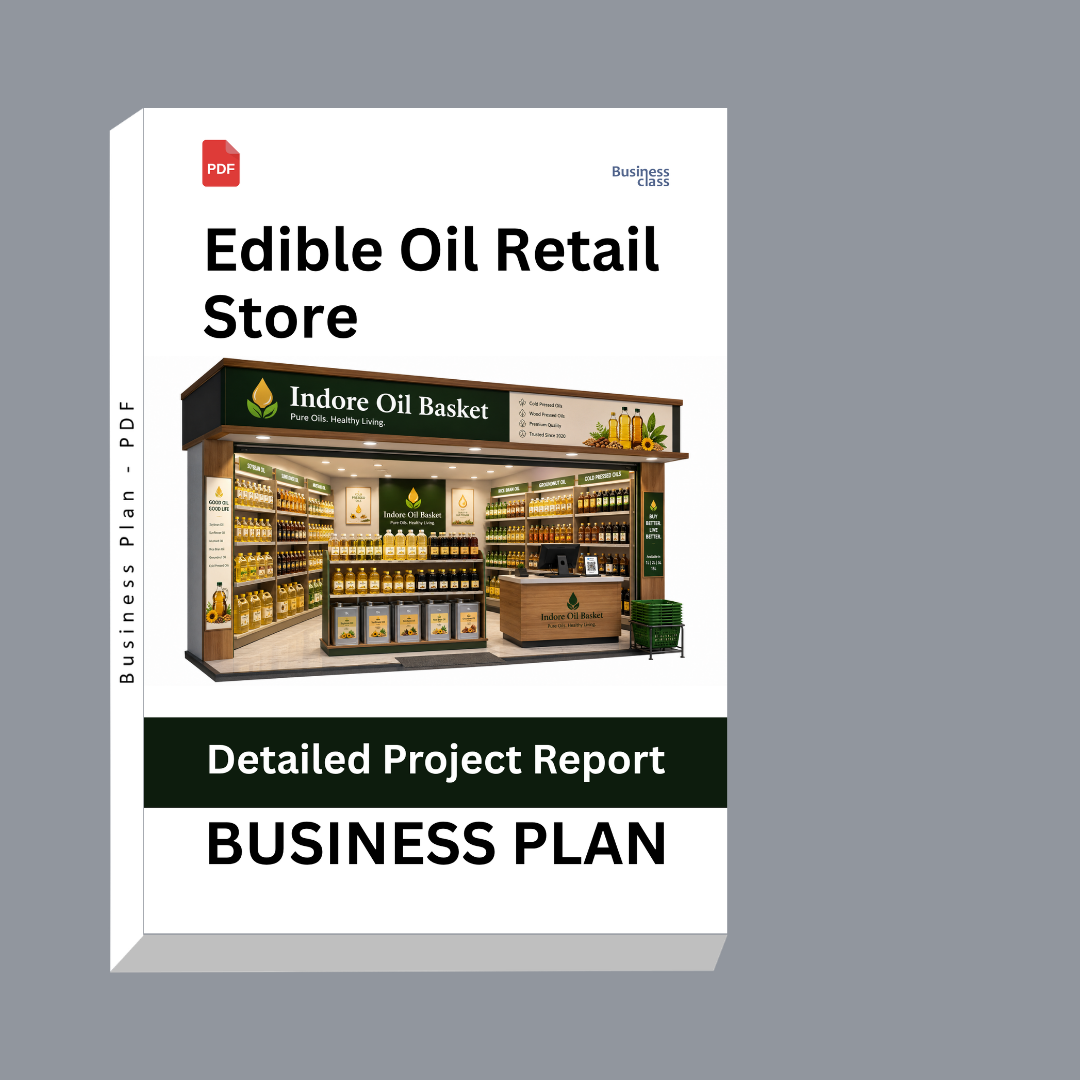
The Edible Oil Retail Store Business Plan is a 44-page English PDF eBook designed for entrepreneurs, small retailers, consultants, students and business planners interested in evaluating or starting a specialist packaged cooking-oil retail store.
Structured as a Detailed Project Report (DPR) and Business Plan, it covers market research, products, pricing, marketing, staffing, operations, infrastructure, inventory, startup capital, cash flow, working capital, break-even analysis, risks, KPIs and launch planning.
Business Overview
The eBook examines an Edible Oil Retail Store operating as a specialist retailer of finished packaged cooking oils rather than an edible-oil manufacturing or extraction business.
The proposed product range includes:
• Everyday refined cooking oils
• Taste-led edible oils
• Premium cold-pressed oils
• Family-size packs
• Larger institutional packs
Potential customers include households, repeat family buyers and selected small food-service businesses.
The model combines walk-in retail, repeat ordering, local delivery for larger packs and occasional B2B sales while emphasizing focused assortment planning, supplier relationships, stock rotation and disciplined working-capital management.
What the Reader Will Learn
Readers can study how to:
• Define a specialist edible-oil retail concept
• Identify household and food-service customers
• Structure refined, premium and institutional product categories
• Develop pricing and margin strategies
• Apply the 7Ps of food retail marketing
• Build a balanced opening assortment
• Plan suitable pack sizes
• Select and manage suppliers
• Receive and inspect packaged oils
• Check seals, packaging and expiry information
• Organize shelves and storage
• Apply stock-rotation procedures
• Monitor fast- and slow-moving products
• Reduce ageing and damaged inventory
• Manage repeat orders and larger-pack delivery
• Maintain accurate billing and stock records
• Establish reorder routines
• Monitor supplier terms and payment timing
• Control shrinkage and inventory losses
• Manage working capital tied up in stock
• Organize founder and staff responsibilities
• Estimate startup capital
• Develop monthly sales and cost plans
• Prepare profit and cash-flow forecasts
• Calculate break-even requirements
• Review funding and loan repayment
• Test downside, base and upside scenarios
• Review operating capacity
• Monitor first-year KPIs
• Prepare launch actions and risk controls
Major Subjects Covered
The eBook includes an executive summary, business concept, market research and marketing strategy covering product, price, place, promotion, people, process and physical evidence.
Operational planning covers procurement, stock receiving, inspection, shelving, billing, sales, repeat-order handling, delivery, day-end closing, weekly stock review and replenishment.
Store setup topics include:
• Retail shelving and racks
• Product-storage areas
• Sales and billing counter
• POS and billing system
• Barcode scanner
• Billing printer
• Digital payment display
• Security monitoring
• Lockable cash storage
• Power backup
• Basic fire-safety equipment
• Packaging materials
• Opening inventory
• Internet and utilities
The staffing model considers an owner-managed structure supported by sales, billing, receiving, packing and delivery responsibilities.
Financial planning includes product costing, sales estimation, variable and fixed expenses, profit planning, cash flow, startup capital, funding sources, loan repayment, working capital, break-even and scenario analysis.
Additional sections cover capacity utilization, founder readiness, supplier diversification, launch planning, compliance scheduling, first-year KPIs, plan-defense questions, assumptions, major risks, mitigation measures and final viability assessment.
Who This eBook Is For
This eBook may be useful for:
• Entrepreneurs planning an Edible Oil Retail Store
• Existing grocery and food retailers
• First-time specialty retail founders
• Consultants preparing Business Plans or DPRs
• Students studying food-retail models
• Prospective borrowers preparing funding discussions
Product Specifications
Product Type: Business Planning eBook
Format: PDF
Subject: Edible Oil Retail Store
Planning Format: Detailed Project Report (DPR) and Business Plan
Language: English
Page Count: 44 pages
Business Model: Specialist packaged edible-oil retail store
Product Coverage: Refined cooking oils, taste-led oils, premium cold-pressed oils, family packs and larger institutional packs.
Coverage: Market research, marketing, staffing, operations, infrastructure, inventory, costing, sales, profit, cash flow, startup capital, funding, repayment, break-even, scenarios, working capital, KPIs, risks and launch planning.
Frequently Asked Questions
1. Is this an edible-oil manufacturing business plan?
No. It focuses on retailing finished packaged edible oils.
2. What products are covered?
Refined oils, taste-led oils, premium cold-pressed products and larger family or institutional packs.
3. Does it cover inventory management?
Yes. Receiving, inspection, stock rotation, replenishment, shrinkage and working-capital controls are addressed.
4. Does it cover store setup?
Yes. Shelving, storage, billing equipment, barcode scanning, security, power backup and safety equipment are included.
5. Is financial planning included?
Yes. It covers sales, costs, profit, cash flow, startup capital, funding, repayment, break-even and scenarios.
6. Can the figures be used directly?
No. Costs, demand, financing, supplier terms, regulations and operating assumptions should be independently validated.
Disclaimer
This eBook is for educational and business-planning purposes only. Financial estimates and operating assumptions require independent validation. Oil type, ingredients, additives, allergen or nutrition information, purity and quality claims, batch and expiry information, packaging integrity, storage conditions, labelling, authenticity, supplier documentation, food-safety requirements, transport, consumer-protection rules, legal, tax, regulatory, financing and insurance conditions vary by product and jurisdiction. Readers should conduct due diligence and obtain appropriate food-safety, legal, financial or regulatory advice before making business, investment or operational decisions.
Share